In today’s hyper-competitive landscape, leaders can no longer rely on gut instinct alone. Data-driven decision-making has become the gold standard, and forecasting plays a central role in it. Whether you’re steering a startup or managing a global enterprise, the ability to anticipate trends, customer behavior, and market shifts can be the difference between thriving and merely surviving.
An Engaging Introduction
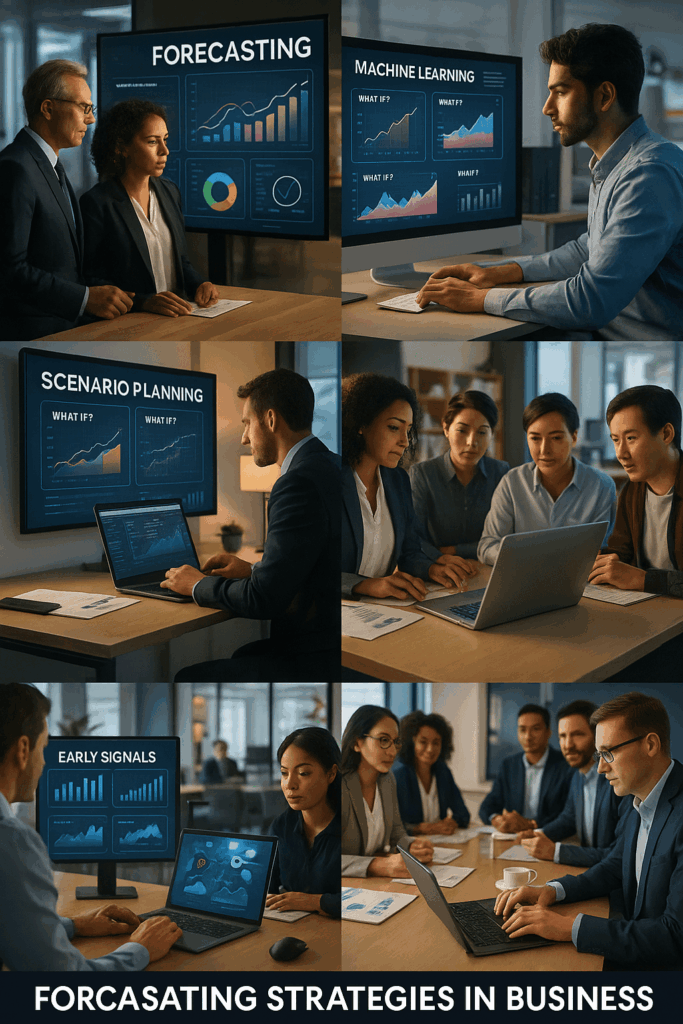
But here’s the twist: while everyone talks about “data,” not many truly know the strategies that make forecasting accurate and impactful. Let’s dive into 7 powerful forecasting strategies that every data-driven leader must know.
1. Time Series Analysis for Trend Prediction
Why It Matters
Time series analysis helps businesses identify patterns in data over time. It’s particularly useful for sales forecasting, demand planning, and financial projections.
Real-World Example
Amazon uses time series models to anticipate seasonal spikes in online shopping, ensuring warehouses are stocked appropriately.
Action Tip
Start with tools like Python’s ARIMA or Facebook Prophet to experiment with your own datasets.
2. Scenario Planning for Uncertainty Management
The Power of “What If”
Scenario planning allows leaders to test multiple futures—best case, worst case, and likely scenarios.
Storytelling
During the COVID-19 pandemic, airlines that ran scenario planning were better prepared to scale down operations while planning for recovery phases.
Action Tip
Involve cross-functional teams to generate diverse perspectives when building scenarios.
3. Machine Learning for Predictive Accuracy
Why Leaders Love It
Machine learning (ML) can process massive datasets and uncover hidden relationships that traditional models often miss.
Real-World Example
Netflix uses ML algorithms to forecast what viewers will watch next, keeping users engaged and reducing churn.
Action Tip
Explore ML platforms like TensorFlow or Azure ML that offer plug-and-play forecasting solutions.
4. Regression Analysis for Demand Forecasting
The Basics That Still Work
Regression models remain a reliable forecasting tool, especially for demand and pricing strategies.
Storytelling
A retail chain applied regression analysis to understand how advertising spend influenced sales, resulting in smarter budget allocation.
Action Tip
Combine regression with external data such as weather or economic indicators for greater accuracy.
5. Leading Indicators for Early Signals
Stay Ahead of the Curve
Instead of waiting for lagging metrics like revenue, focus on leading indicators such as website traffic, customer inquiries, or social media mentions.
Real-World Example
Tech companies often use app download rates as an early sign of product adoption before sales figures arrive.
Action Tip
Identify 2–3 leading indicators specific to your industry and track them weekly.
6. Collaborative Forecasting with Stakeholders
Why Collaboration Wins
Forecasting improves dramatically when sales, marketing, finance, and operations align their insights.
Storytelling
A global FMCG brand saw a 15% improvement in forecast accuracy after adopting collaborative forecasting between sales and supply chain teams.
Action Tip
Use tools like Salesforce or SAP Integrated Business Planning to enable collaborative input.
7. Real-Time Forecasting with AI and IoT
The Next Frontier
With AI and IoT, forecasting no longer needs to be static. Businesses can adjust forecasts in real time as new data streams in.
Real-World Example
Logistics companies now integrate IoT sensors to predict delivery delays and reroute shipments proactively.
Action Tip
If you’re just starting, begin with real-time dashboards that refresh data automatically before scaling into AI-driven models.
Conclusion
Forecasting isn’t about predicting the future with absolute certainty—it’s about preparing your business to respond intelligently to whatever the future holds. From tried-and-true regression models to advanced AI-driven real-time forecasting, these 7 strategies empower leaders to stay agile and competitive.
Call-to-Action:
Don’t wait for uncertainty to catch you off guard. Start applying one of these forecasting strategies today, test it with your data, and watch how predictive insights transform your decision-making.
