Customer service is no longer just about answering questions—it’s about creating seamless, personalized experiences that customers actually remember. In a world where expectations are sky-high and competition is fierce, companies that fail to innovate will quickly fall behind. That’s why intelligent customer service, powered by AI, data, and smart technology, is becoming the new standard.
The New Era of Customer Service
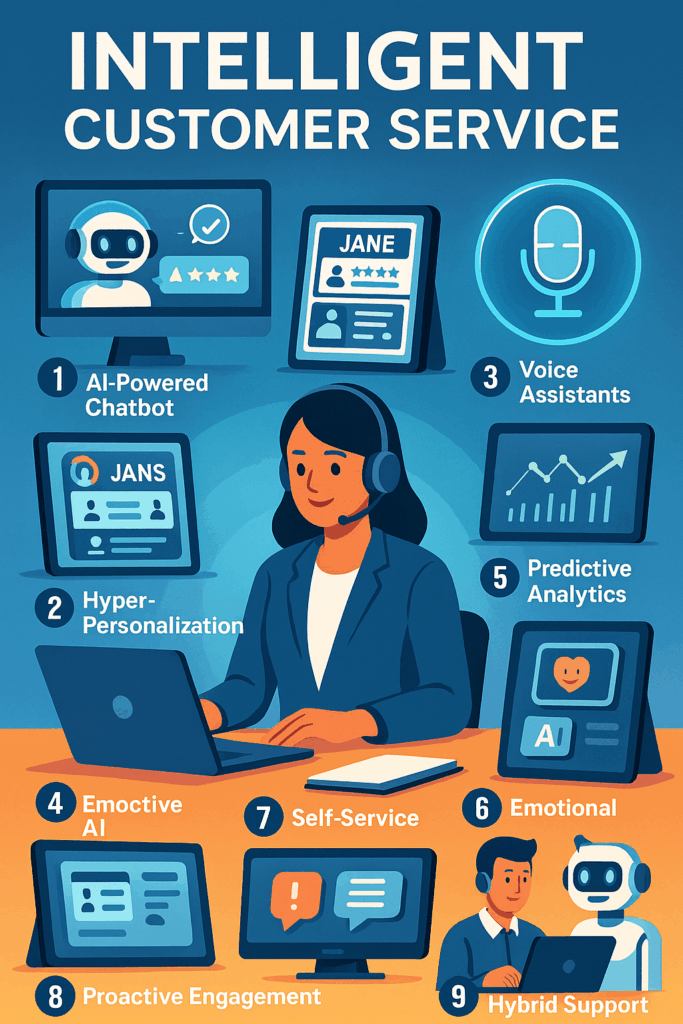
In this article, we’ll explore 9 customer service trends every business must watch to stay competitive and relevant.
1. AI-Powered Chatbots as First-Line Support
Why It Matters
AI chatbots are now smart enough to handle complex queries, not just scripted FAQs. They save time, reduce costs, and provide 24/7 support.
Example
Sephora’s chatbot assists customers in choosing beauty products tailored to their skin type, increasing engagement and conversion rates.
2. Hyper-Personalized Customer Experiences
The Trend
Personalization has gone beyond “Hello [Name].” AI now leverages data to offer product recommendations, content, and support tailored to each individual.
Data Point
A study by Epsilon shows 80% of consumers are more likely to purchase from brands that deliver personalized experiences.
3. Voice Assistants in Customer Service
Why It’s Growing
With Alexa, Google Assistant, and Siri becoming mainstream, customers expect voice-enabled support.
Storytelling
Imagine a customer reordering groceries simply by saying, “Alexa, reorder last week’s list.” That’s frictionless service.
4. Omnichannel Integration Becomes the Norm
What It Means
Customers switch between social media, apps, email, and phone without wanting to repeat themselves. Businesses need seamless omnichannel integration.
Example
Starbucks’ app syncs payments, rewards, and customer interactions across in-store and digital channels, offering a consistent experience everywhere.
5. Predictive Customer Service with Data Analytics
The Future of Support
Instead of waiting for customers to complain, predictive analytics identifies issues before they escalate.
Example
Airlines use predictive systems to notify passengers about potential delays and suggest alternative flights before frustration builds.
6. Emotional AI for Better Empathy
The Trend
AI is evolving to detect human emotions through voice tone, text sentiment, or facial cues, allowing responses that feel more empathetic.
Example
Call centers are experimenting with AI tools that alert agents when a caller sounds stressed, prompting them to adjust their tone and offer reassurance.
7. Self-Service Portals and Knowledge Bases
Why Customers Love It
Many customers prefer finding solutions themselves instead of waiting for an agent. AI-driven self-service platforms make this faster and more intuitive.
Example
Microsoft’s AI-powered knowledge base directs users to the most relevant solutions, reducing ticket volume and empowering users.
8. Proactive Customer Engagement
The Shift
Instead of passively waiting, brands are starting conversations proactively—sending helpful reminders, updates, or offers before customers even ask.
Example
Telecom companies notify customers about data usage and offer top-up options before they run out, preventing service disruptions.
9. Human + AI Hybrid Support Models
Why It Works
The best customer service combines AI efficiency with human empathy. Chatbots handle routine tasks, while human agents resolve complex or emotional issues.
Storytelling
Think of it like a relay team: AI passes the baton to humans when the query requires empathy or creative problem-solving.
Conclusion: Intelligent CX Is the Competitive Edge
Customer service has evolved from being reactive to becoming predictive, personalized, and intelligent. These 9 trends show that the future isn’t about replacing humans, but about empowering them with smarter tools. Businesses that adopt these innovations will not only meet customer expectations but exceed them—turning every interaction into a loyalty-building moment.
Call-to-Action:
Take a closer look at your customer service strategy today. Which of these trends can you implement now to get ahead—and which ones do you need to prepare for before your competitors do?
