Have you ever wondered how global companies manage to stay ahead in today’s ultra-competitive business landscape? The answer often lies in how effectively they leverage data—and more importantly, how they use machine learning (ML) to turn that data into decisions. Far from being just a buzzword, ML is now at the heart of modern business operations. From automating routine tasks to uncovering patterns that humans might miss, machine learning is redefining what’s possible across industries.
Why Machine Learning is No Longer Optional
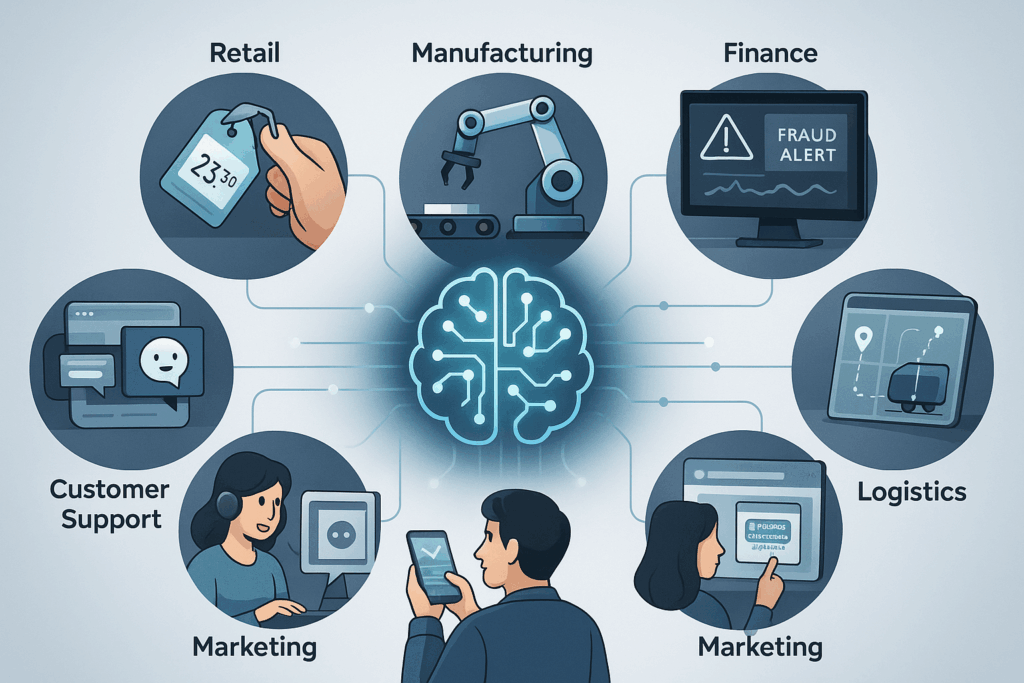
In this article, we’ll walk you through six real-world examples of how machine learning is actively driving business efficiency. Whether you’re in retail, logistics, finance, or tech, these use cases are a glimpse into what your business can achieve with the right data-driven strategy.
1. Customer Service Automation with Chatbots
Reducing Workload While Enhancing Customer Experience
Chatbots powered by machine learning are revolutionizing how businesses handle customer inquiries. Companies like Sephora and H&M use AI-driven bots to handle thousands of customer messages daily—ranging from order tracking to product recommendations.
How It Works
ML models are trained on past interactions and continuously improve by learning from new conversations. Natural Language Processing (NLP) enables these bots to understand context, tone, and intent—making them feel more “human.”
Real Impact
- Zendesk reports that AI bots can resolve up to 80% of standard queries without human intervention.
- Businesses see a 25%+ decrease in support costs and faster resolution times.
2. Predictive Maintenance in Manufacturing
Avoiding Downtime Before It Happens
Imagine knowing a machine will fail before it actually does. That’s the power of ML in predictive maintenance. Companies like Siemens and General Electric use machine learning algorithms to analyze sensor data from machinery and flag early warning signs.
How It Works
ML models analyze data points such as vibration, temperature, and sound to predict when a component might fail.
Real Impact
- Downtime reduced by up to 30%
- Maintenance costs cut by 25% or more
- Increased safety and efficiency in plant operations
3. Dynamic Pricing in Retail and E-commerce
Real-Time Price Adjustments That Maximize Profit
Have you noticed how flight or hotel prices change rapidly? That’s dynamic pricing in action. Online platforms like Amazon and Booking.com use machine learning to adjust prices in real time based on demand, competition, and user behavior.
How It Works
By analyzing millions of data points (like browsing history, purchase intent, and competitor prices), ML algorithms set the “optimal” price at any given moment.
Real Impact
- 20%–30% increase in conversion rates
- Higher average order value
- More efficient inventory management
4. Fraud Detection in Finance
Protecting Customers and Institutions in Real Time
Banks and fintech companies are investing heavily in ML to detect and prevent fraudulent transactions. PayPal, for instance, uses a proprietary ML model that monitors all transactions in real-time.
How It Works
ML algorithms look for anomalies in transaction behavior—such as odd locations, unusual purchase amounts, or sudden changes in login patterns.
Real Impact
- Fraud loss reduction of up to 40%
- Real-time alerts for suspicious activity
- Increased customer trust and platform security
5. Supply Chain Optimization
Predicting Demand, Managing Stock, Reducing Costs
Companies like Walmart and Unilever use ML to forecast product demand, optimize routes, and reduce waste in their supply chains.
How It Works
ML models process historical sales data, seasonal trends, and even weather forecasts to predict what products will be needed, where, and when.
Real Impact
- Inventory carrying costs reduced by 20%
- Stock-outs minimized by 30%
- Faster delivery and higher customer satisfaction
6. Personalized Marketing and Recommendations
Tailoring Offers That Actually Convert
Streaming services like Netflix and online stores like Spotify or Amazon don’t just recommend random content—they use ML to suggest what you’re most likely to enjoy or buy next.
How It Works
User behavior is tracked in real-time: what you click, how long you stay, what you skip. ML algorithms then predict what you’re most likely to engage with next.
Real Impact
- Personalized recommendations increase revenue by up to 20%
- Boosts engagement, click-through rates, and customer retention
Conclusion: The Machine Learning Advantage is Clear
Machine learning isn’t just a trend—it’s a core driver of competitive advantage. Whether you’re looking to automate routine tasks, prevent costly errors, or offer hyper-personalized experiences, ML can significantly enhance your business processes.
The six examples above are just the beginning. With the right strategy and tools, even small and medium-sized businesses can start reaping the benefits. The key is to start small, test iteratively, and scale intelligently.
Ready to make machine learning part of your business DNA? Start by identifying one problem ML could solve in your workflow—and explore from there. The future of business belongs to those who harness data to act smarter and faster.
