Meta description (155 chars):
Discover 9 practical, game-changing benefits of responsible AI in the workplace—from fair hiring and safer decisions to stronger brands and faster innovation.
A quick hook:
Everyone’s racing to plug AI into workflows. But there’s a catch: “smarter” isn’t always safer—or fairer. The companies winning today aren’t the ones who deploy AI the fastest; they’re the ones who deploy it responsibly. That means models that are explainable, governed, bias-checked, secure, and designed with people in mind. The payoff? Better decisions, lower risk, and trust you can actually measure.
why responsible beats just “smart”
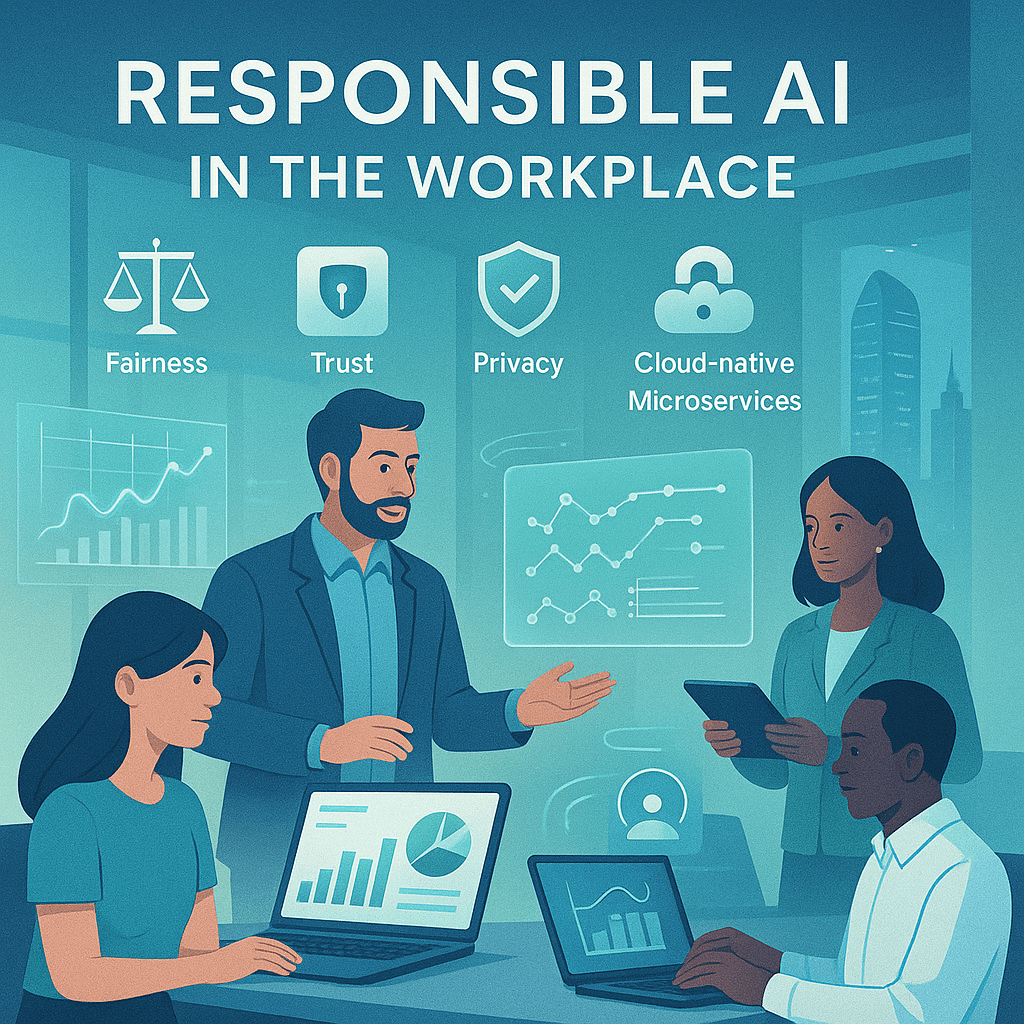
Below are nine benefits you can start unlocking right now—plus practical steps to make them real.
What do we mean by “responsible AI”?
Responsible AI is the discipline of designing, developing, and deploying AI systems that are lawful, ethical, and sustainable. In practice, it blends:
- Governance: policies, model inventories, approval workflows
- Safety: bias testing, robustness checks, red-teaming
- Transparency: explainability, documentation (model cards, data sheets)
- Privacy: data minimization, consent, secure storage, differential privacy
- Human oversight: human-in-the-loop (HITL), clear escalation paths
1) Fairer hiring and promotion decisions
The benefit: Reduce hidden bias and widen your talent pool.
How it works: Use bias-aware screening tools with audited datasets and monitored outcomes. Pair automation with structured human review.
Story: A mid-size fintech noticed fewer women progressing past its technical screen. By adding bias checks (and retraining on balanced data), pass-through rates equalized without lowering the bar—and time-to-hire fell by a week.
Quick win (H4): Run a pre-deployment fairness audit on your recruiting models (e.g., adverse-impact analysis). Document results in a simple model card and set a monthly review.
2) Decisions you can actually explain
The benefit: Transparency increases trust with staff, customers, and regulators.
How it works: Use interpretable models where feasible, build explanations (reason codes, feature importance), and attach decision summaries to outputs.
Example: A lending bot provides top three drivers for each decision (“income stability,” “debt ratio,” “repayment history”) and flags edge cases for manual review. Approval times drop while complaint rates fall because people understand the “why.”
Quick win: Add a “Why this result?” explainer to any AI-powered decision that affects people (credit, pricing, support prioritization).
3) Lower regulatory and legal risk
The benefit: You avoid fines, rework, and brand damage.
How it works: Map AI use cases to applicable rules (privacy, sector-specific), maintain a model registry, and require a go/no-go risk review before production.
Example: An HR chatbot that summarizes policies is scoped to non-sensitive data, logs conversations, and masks personal identifiers. When a compliance review arrives, the company can show policies, controls, and evidence in hours—not weeks.
Quick win: Create a one-page AI Risk Checklist (data sources, evaluation metrics, privacy controls, escalation). Make it mandatory at kickoff.
4) Privacy by design builds durable customer trust
The benefit: You protect people while enabling insight.
How it works: Apply data minimization (collect only what’s needed), pseudonymization, access controls, and retention limits. For analytics, explore synthetic data or privacy-enhancing techniques.
Story: A retailer moved product-recommendation training to pseudonymized, event-level data. Personal data stayed in a separate, locked domain. Conversion gains remained, privacy risk dropped.
Quick win: Add a data retention timer for training sets. Expire or refresh datasets on a fixed schedule.
5) Happier employees, not replaced employees
The benefit: Responsible AI augments people instead of sidelining them.
How it works: Identify tasks, not jobs, for automation. Keep humans “on the loop” for complex or high-impact steps. Measure load reduction and quality uplift.
Example: A legal team deploys a drafting assistant with guardrails: it cites sources, highlights low-confidence sections, and requires human approval. Lawyers spend more time on strategy and less on formatting.
Quick win: Add a confidence threshold + human review step for any AI output sent to customers or regulators.
6) Better customer experiences—and fewer escalations
The benefit: Faster, more accurate help that still feels human.
How it works: Blend retrieval-augmented generation (RAG) with curated knowledge bases, add tone controls, and train on real support transcripts while filtering sensitive data.
Story: A telco’s virtual agent moved from generic answers to source-backed responses. CSAT rose because the bot linked to policy pages and handed off cleanly when it wasn’t sure.
Quick win: Implement a “graceful fallback”: if confidence < X, the bot gathers context and transfers to a person—no dead ends.
7) Stronger brand and employer reputation
The benefit: Trust becomes a competitive moat.
How it works: Publish AI principles, show your governance process, and share results (e.g., accessibility improvements, fairness outcomes). Candidates want to join companies that use tech responsibly.
Example: A consumer bank publishes a short Responsible AI report each quarter—what’s deployed, the tests run, and what improved. Media coverage turns a risk topic into a strength.
Quick win: Create a public Responsible AI page with your principles, oversight structure, and a contact for questions.
8) Faster, safer innovation
The benefit: Guardrails reduce rework and accelerate pilots.
How it works: Pre-approve reference architectures (for chatbots, forecasting, classification), security patterns, and testing templates. Teams reuse the safe path instead of reinventing controls.
Story: A healthcare startup standardized on a vetted RAG stack with PHI controls and red-teaming scripts. Time from idea to pilot shrank from months to weeks.
Quick win: Publish an internal AI Starter Kit: boilerplate code, model-card template, evaluation checklist, and a sample DPIA (Data Protection Impact Assessment).
9) Measurable ROI with fewer fire drills
The benefit: You ship value and sleep at night.
How it works: Track hard metrics (cycle time, cost per ticket, error rate) and trust metrics (complaints, escalation rate, audit findings). Responsible AI prevents expensive rollbacks.
Example: After adding governance and explainability to a forecasting tool, an ops team cut manual corrections by 30% and eliminated quarterly audit exceptions. Savings paid for the program itself.
Quick win: Instrument every AI workflow with before/after KPIs and a “kill switch” if metrics or risk thresholds drift.
Implementation roadmap (H2)
Step 1: Set principles and owners (H3)
- Draft 5–7 plain-English AI principles (fairness, privacy, transparency, safety, accountability).
- Assign product + risk co-ownership for every use case.
Step 2: Inventory and classify your models (H3)
- Maintain a living registry: purpose, data sources, evaluation metrics, owner, last review.
- Tag use cases by risk level (low/medium/high) to right-size controls.
Step 3: Standardize testing (H3)
- Fairness: adverse-impact tests across key cohorts.
- Robustness: edge cases, prompt injection, stress tests.
- Quality: task-specific metrics (accuracy, latency, hallucination rate).
- Security & privacy: data lineage, access logs, redaction checks.
Step 4: Build human-in-the-loop by default (H3)
- Define when humans intervene (low confidence, high impact, sensitive contexts).
- Capture feedback to continuously retrain models.
Step 5: Communicate openly (H3)
- Add “AI used here” disclosures where relevant.
- Offer appeal paths for decisions and publish a contact for questions.
Real-world mini case study (H2)
Context: A regional insurer wanted AI to handle first-notice-of-loss claims.
- Challenge: Early prototypes hallucinated policy clauses and mishandled sensitive PII.
- Responsible approach: They deployed a governed RAG pipeline tied to the official policy library, masked PII in logs, added a confidence threshold, and built a supervisor queue.
- Results: Average handling time dropped 28%, re-work fell, and the audit team signed off on the architecture. Customer satisfaction improved because explanations were clear and escalation was fast.
SEO tidbits you can apply today (H2)
On-page (H3)
- Use intent-rich headers like “Responsible AI Benefits”, “AI Governance Checklist”, and “Human-in-the-Loop Examples.”
- Add internal links to related pages (privacy policy, security posture, careers).
Content signals (H3)
- Include model cards, process diagrams, and case snapshots with measurable outcomes.
- Publish a short Responsible AI update each quarter to earn freshness points.
Technical (H3)
- Mark up FAQs (if added) with FAQPage schema.
- Optimize page speed; AI content pages often have diagrams or iframes—lazy-load where possible.
Conclusion: Trust is the ultimate productivity hack
Responsible AI isn’t red tape—it’s how you scale AI with confidence. When bias is monitored, data is protected, decisions are explainable, and humans remain in the loop, you get faster delivery and fewer surprises. Start with one high-impact workflow, apply the guardrails above, measure the before/after, and share the win. That’s how a responsible AI culture takes root.
Call to action:
Want a simple checklist and templates (model card, risk review, evaluation plan) tailored to your team? Tell me your top AI use case and team size—I’ll generate a lightweight, ready-to-use Responsible AI starter kit you can deploy this month.
